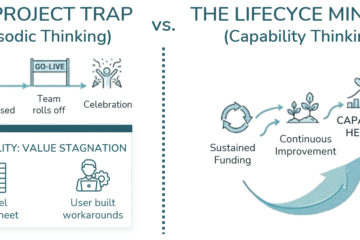
The Problem Starts After the Tool Goes Live
A lot of organizations are past the point of asking whether AI matters.
The tools are already here. Teams are trying Copilot, ChatGPT, agents, workflow automation, and AI-assisted reporting. On paper, that looks like momentum. But usage is not the same thing as adoption, and this is the part many organizations underestimate. It is one thing to give people access to AI. It is another thing to change how work actually gets done.
Someone shows how AI can summarize a meeting, draft an email, generate a proposal outline, build a first version of a report, or pull information from a knowledge base. Everyone sees the potential. Then the tool goes live, and the real challenge starts.
Some people use it right away. Some avoid it. Some use it in ways that create risk. Some try it once, get a bad answer, and decide it does not work. Some managers reinforce it. Others never mention it again. Before long, the organization has a familiar problem: the technology exists, but the behavior around it is inconsistent.
That is where AI adoption becomes a change management issue. If people do not trust the tool, understand where it fits, then the rollout will stall.
The goal here is not just to introduce AI into the business. The goal is to help teams adopt it in a way that supports clarity, execution, and measurable outcomes.
Adoption Has to Win the Head, the Heart, and the Herd
A strong AI change management framework has to address three things at the same time: the head, the heart, and the herd.
The head is the logical case. People need to understand what the tool does, where it belongs, and how it supports the work they already own. This is where the business case matters. If the message is vague, adoption will be vague too.
People need to know what success looks like. Are we trying to reduce manual reporting time? Improve handoffs between sales and marketing? Make client data easier to find? Create more consistent proposal drafts? Shorten response times? Improve service quality?
If the answer is just “use AI more,” that is not a strategy.
The heart is the emotional reality. AI changes how people think about their work. Some employees are excited. Some are skeptical. People’s concerns cannot be brushed aside.
If people feel like AI is being handed to them as another productivity mandate, they may comply without actually changing behavior. They may try it just enough to say they used it. They may keep doing the real work the old way because it feels safer.
The herd is the social layer. People watch what the team rewards. They watch what managers do. They watch whether peers are using the tool in real work or only talking about it during training. They notice whether AI is part of the operating rhythm or just something leadership announced once. That is why adoption is never just individual but rather cultural.
Managers Are the Reinforcement Layer
In most organizations, employees do not take their behavioral cues from a launch email. They take them from their direct manager. Managers need to know how to translate AI into the reality of their team’s work. For sales, that may mean using AI to prep for account planning, summarize CRM history, or draft follow-up language. For marketing, it may mean using AI to structure campaign briefs, compare messaging themes, or speed up content review.
Managers also need permission to be honest. AI will not be perfect every time. Some outputs will be wrong. Some will be average. Some will need human judgment. That does not mean the tool failed. It means the team needs a better operating model around it.
A good manager-led adoption model does not pretend AI removes responsibility. It helps people understand where AI can accelerate the work and where human review still matters.
Start With the Humans, Then Scale the Technology
AI adoption is not just a technical rollout. It is a behavior change. Kumo helps organizations move from AI interest to a working adoption model by identifying where AI fits, which use cases matter most, what process or data issues need to be addressed, and how teams should be supported after launch.
For clients already working in Microsoft environments, that often means connecting tools like Copilot, Copilot Studio, Power Platform, Dataverse, SharePoint, Dynamics 365, and Power BI to the work already happening inside the business. The goal is not to force AI everywhere. It is to find the right places where AI can reduce friction, improve consistency, and support better decisions.
The difference between having AI tools and building AI habits comes down to structure, clarity, and reinforcement. Kumo helps clients create that foundation through readiness assessments, adoption workshops, use case prioritization, governance planning, and targeted agent or workflow development.