What is going on
You bought the Copilot licenses.
Your team has agent ideas.
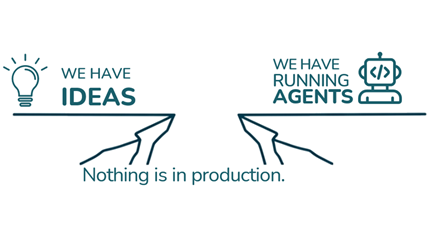
Six months later, nothing is in production.
That pattern is showing up everywhere in the mid-market right now. Microsoft is moving fast on Copilot Studio. Organizations are buying ahead of their delivery capability. And the gap between “we have ideas” and “we have running agents” keeps getting wider.
Here is what that gap is actually costing you.
As a result, every quarter, an agent idea sits in backlog is another quarter your team does the work the agent was supposed to do. The new hire is still emailing HR. The CSM is still hand-writing follow-ups. The ops lead is still reconciling status updates from three systems. You are paying for the platform. You are not getting the productivity.
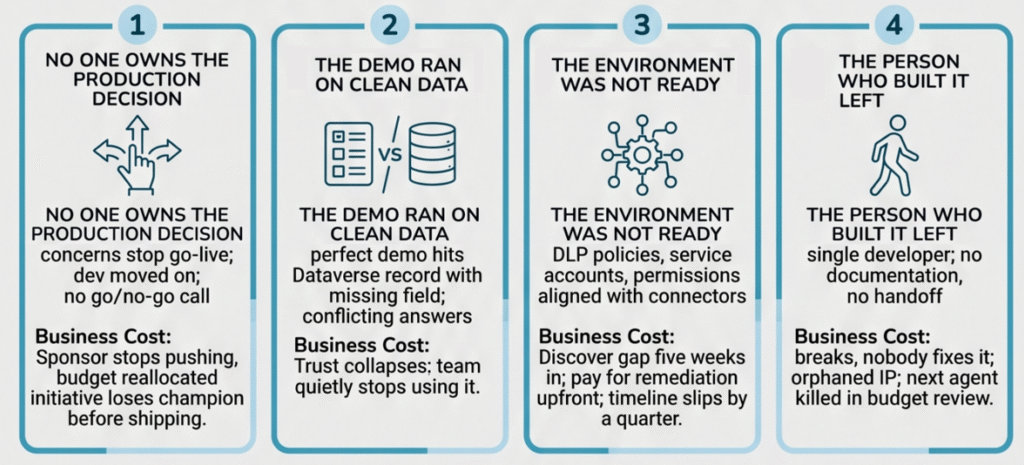
However, the reason your backlog is not moving has almost nothing to do with the technology. It comes down to four operational gaps.
1. No One Owns the Production Decision
For example, in a PoC, ownership is obvious. One developer, one sponsor, one demo audience.
However, the decision to ship into production is different. IT raises concerns. The business sponsor pushes. The developer has already moved on to the next thing. No one is accountable for the go/no-go call, so it doesn’t happen.
The business cost: Your sponsor stops pushing for AI. Budget gets reallocated. The initiative loses its champion before it ever ships a result.
2. The Demo Ran on Clean Data
Test data is curated. By contrast, production data is not. The agent that nailed every question in the demo hits a Dataverse record with a missing field and starts giving conflicting answers.
The business cost: Trust collapses on contact with reality. The team that championed the agent quietly stops using it. Adoption never starts, and your investment delivers nothing measurable.
3. The Environment Was Not Ready
In addition, Agents need DLP policies aligned to their connectors, service accounts with the right permissions, and governance that can support a production workload. Most mid-market tenants are not configured for that out of the box.
The business cost: You discover the gap five weeks into a build. Now you are paying for remediation that should have happened up front, and the project timeline slips by a quarter.
4. The Person Who Built It Left
Finally, a single developer with no documentation, no handoff process, and no internal team member who really understands the agent is a recipe for an outage.
The business cost: When the developer leaves, your production agent becomes orphaned IP. It breaks, nobody fixes it, and leadership starts treating AI as a category that does not deliver. The next agent idea gets killed in budget review.
These Are Operational Failures, Not Technical Ones
Copilot Studio works.
Power Platform works.
The platform is not the problem.
The problem is the delivery model.
A PoC answers one question: “Can this work?” It does not answer the question your CFO will ask: “Can this work in our environment, reliably, for two years, with a return we can measure?”
That is a different problem. It requires a different engagement model.
A Delivery Model Built for Production
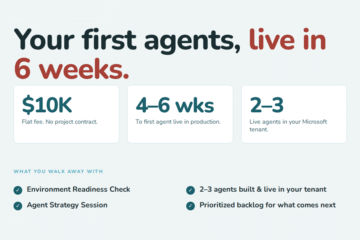
We built the AgentDesk Pilot specifically to close this gap. A fixed $10,000, six-week engagement. Two to three live Copilot agents in your environment. Production-grade from day one. No project contract.
Here is how it addresses each of the four operational gaps you just read.
Here is how it addresses each of the four operational gaps you just read.
- Production ownership is defined in the Agent Strategy Session in Week 1, before any build starts. Sponsor, approver, and operator are named in writing.
- Data and environment readiness is verified in the Environment Readiness Check, also Week 1. If something is missing, we tell you immediately. The cost of fixing it is fixed.
- Governance is built into the delivery method, not bolted on at go-live. DLP, connector configuration, and identity are validated against your tenant before the first build.
- Handoff and documentation ship with every agent. You own the source, the documentation, and the deployment blueprint. Your team can maintain what we build.
At the end of six weeks, you have two or three production agents in your environment, your team using them, and a prioritized backlog of the next ten or more. No new contract to sign. No new project to scope. The backlog becomes the pipeline.
That is the business case for AgentDesk in one line.