Data governance has a branding problem. Mention it in a meeting and someone will picture a 74-page policy, three committees, and a spreadsheet whose owner left the company two years ago. To be fair, sometimes that is exactly what governance has been.
It does not have to be.
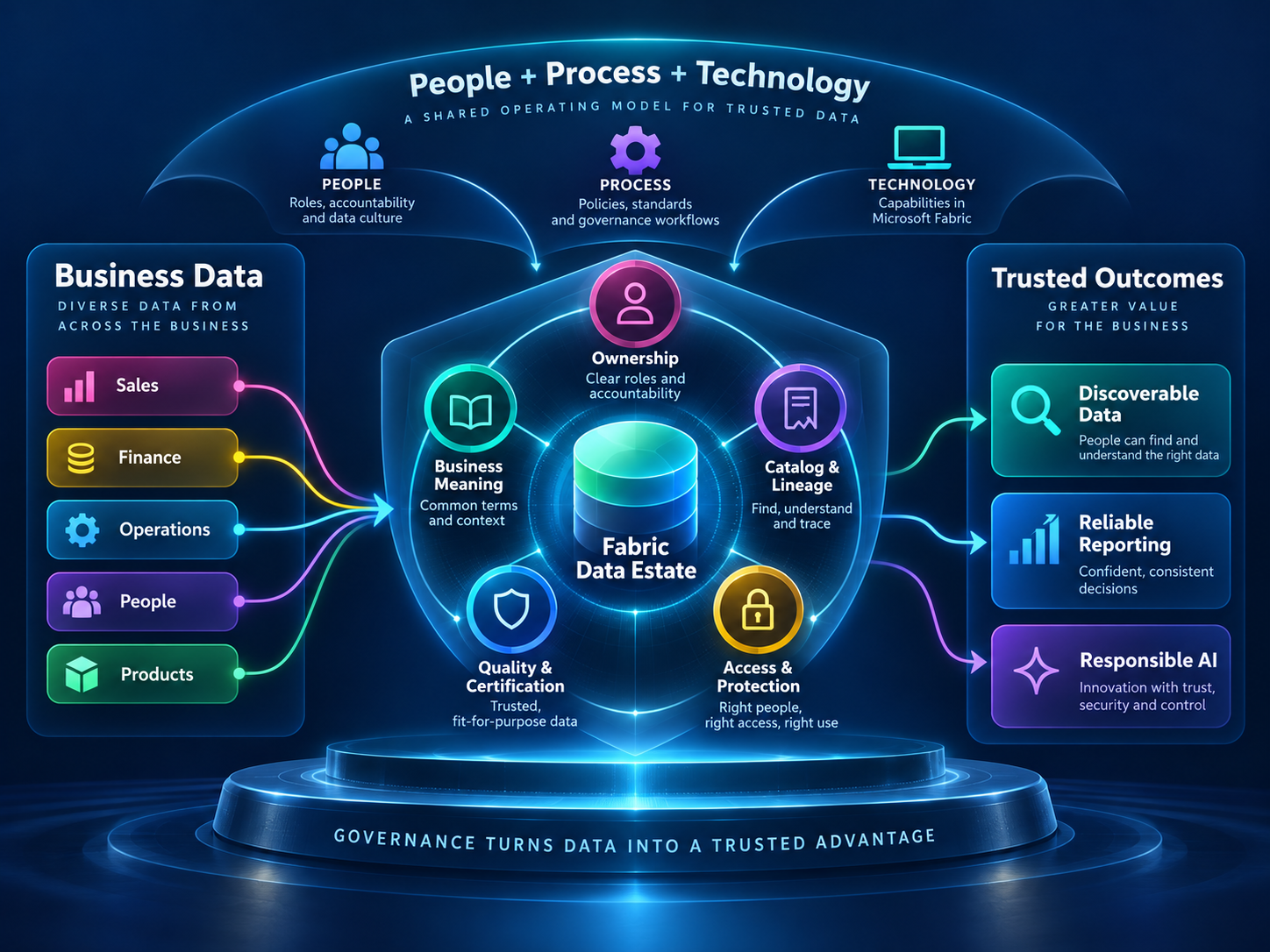
Microsoft Fabric gives teams a genuinely useful place to bring together data engineering, analytics, real-time workloads, Power BI, and AI. What it does not do is decide who owns Revenue, which definition of Active Customer is approved, whether a dataset is safe to use, or who gets the awkward phone call when yesterday’s dashboard changes by 12 percent.
That is the work of governance: combining clear accountability, practical rules, and platform controls so people can find data, understand it, trust it, and use it responsibly.
The goal is not more governance activity. The goal is faster, safer decisions with data people can trust.
Fabric does not govern itself
Microsoft Fabric includes strong governance capabilities, but capabilities are not the same thing as an operating model.
The OneLake catalog is Microsoft’s primary Fabric experience for discovering and governing Fabric data. It brings discovery, governance insights, recommended actions, domains, endorsements, lineage, and administrative experiences into Fabric. Microsoft Purview extends that foundation with information protection, data loss prevention, audit, risk, and compliance capabilities.
Those are excellent building blocks. They still need business ownership, shared definitions, sensible access decisions, quality expectations, and a delivery process. Otherwise, you have purchased a very capable toolbox and left everyone to debate who owns the hammer.
Start with the decision, not the catalog
A governance program should begin with a business outcome someone cares about. For example:
- Finance wants one certified revenue model instead of five almost-identical versions.
- Operations needs people to find trusted inventory data without opening a support ticket.
- Security needs sensitive fields classified and protected when data moves or is exported.
- A data team wants to launch reusable products without rebuilding ownership and quality rules every time.
- An AI initiative needs shared definitions and approved data before an agent starts answering questions with impressive confidence and questionable accuracy.
Starting with a real decision keeps governance grounded. It also gives you something measurable, which is helpful when someone reasonably asks, “What did all this governance work actually buy us?”
Governance is people, process, and technology
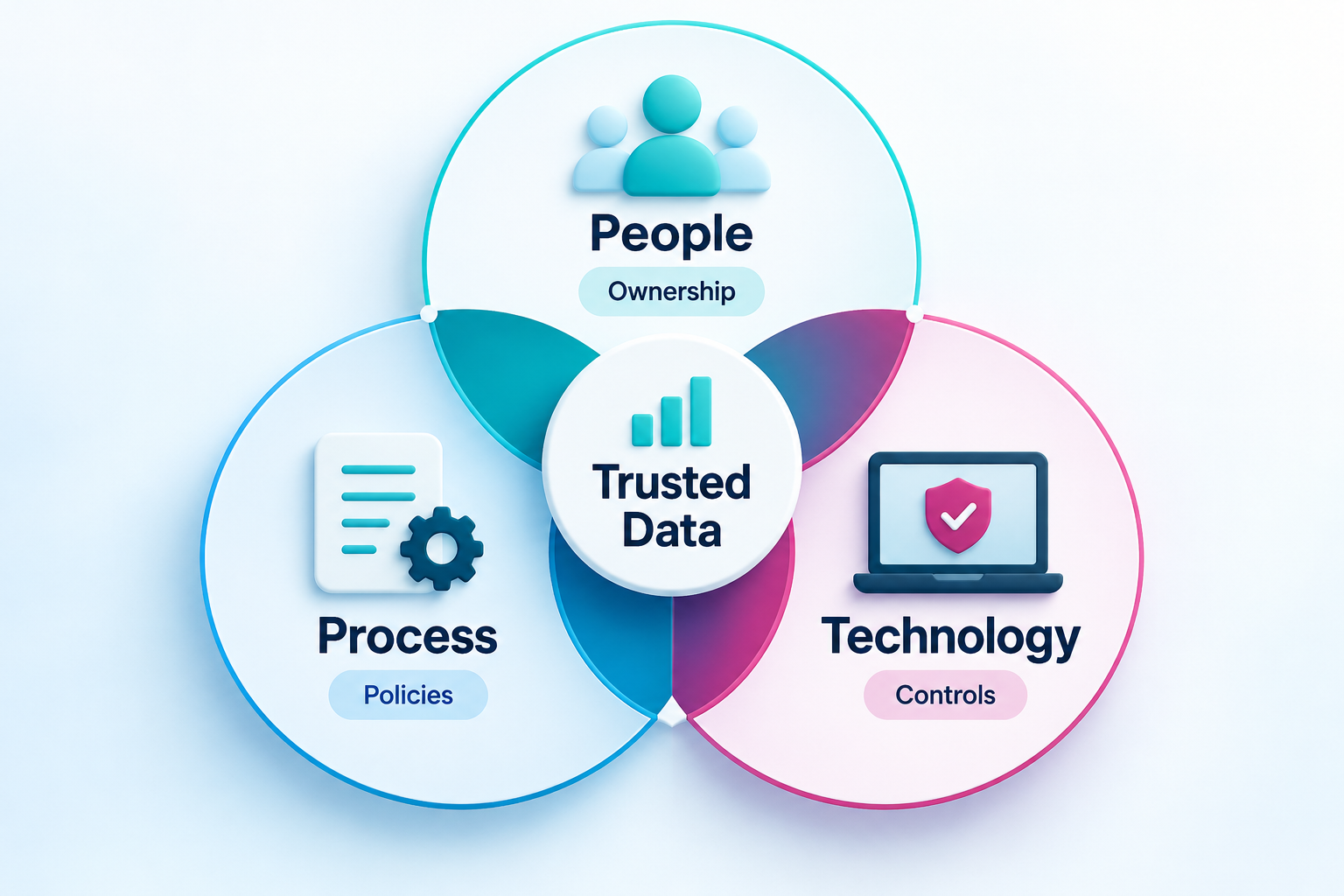
Trusted data appears where accountable people, practical processes, and useful technology meet.
If one part is missing, the model gets wobbly quickly.
Technology without ownership produces alerts nobody owns. Process without usable tools produces policy documents people politely ignore. Ownership without decision rights gives someone accountability without the authority to fix anything—which is less a role and more a practical joke.
Ownership before tooling
We typically define a lightweight set of responsibilities:
- Data owners make business decisions about meaning, acceptable use, quality, and risk.
- Data stewards maintain definitions, metadata, quality rules, and day-to-day issue resolution.
- Platform teams provide secure, repeatable Fabric capabilities and guardrails.
- Domain delivery teams build and operate data products close to the business problems they solve.
- Security and compliance partners translate obligations into proportionate controls and evidence.
One person may wear more than one hat, especially in a smaller organization. That is fine. The important part is that the hat exists, people know who is wearing it, and decisions do not disappear into a committee-shaped fog.
Policies people can actually follow
Good governance rules are specific enough to guide delivery and light enough to use. A practical policy might say what must be true before a semantic model can be certified, which data requires a sensitivity label, how access is approved, or how long a deprecated data product remains available.
“Use data responsibly” is a lovely sentiment. It is not an operating procedure.
Make trusted data easier to find
People should not need tribal knowledge—or a particularly well-connected teammate—to locate the right data.
The OneLake catalog supports discovery across the Fabric estate and gives owners and administrators a place to understand governance posture. Domains help organize content around business areas. Tags and metadata improve search. Lineage helps people trace where data came from and what depends on it. Promotion and certification signal which items are intended for broader use.
The experience should answer a few basic questions quickly:
- What is this data, in business language?
- Who owns it?
- Where did it come from, and what transformed it?
- Is it current and fit for this purpose?
- Am I allowed to use it?
- Which version should I trust?
If the catalog cannot answer those questions, adding more catalog entries will mostly create a larger catalog.
Treat important data as a product
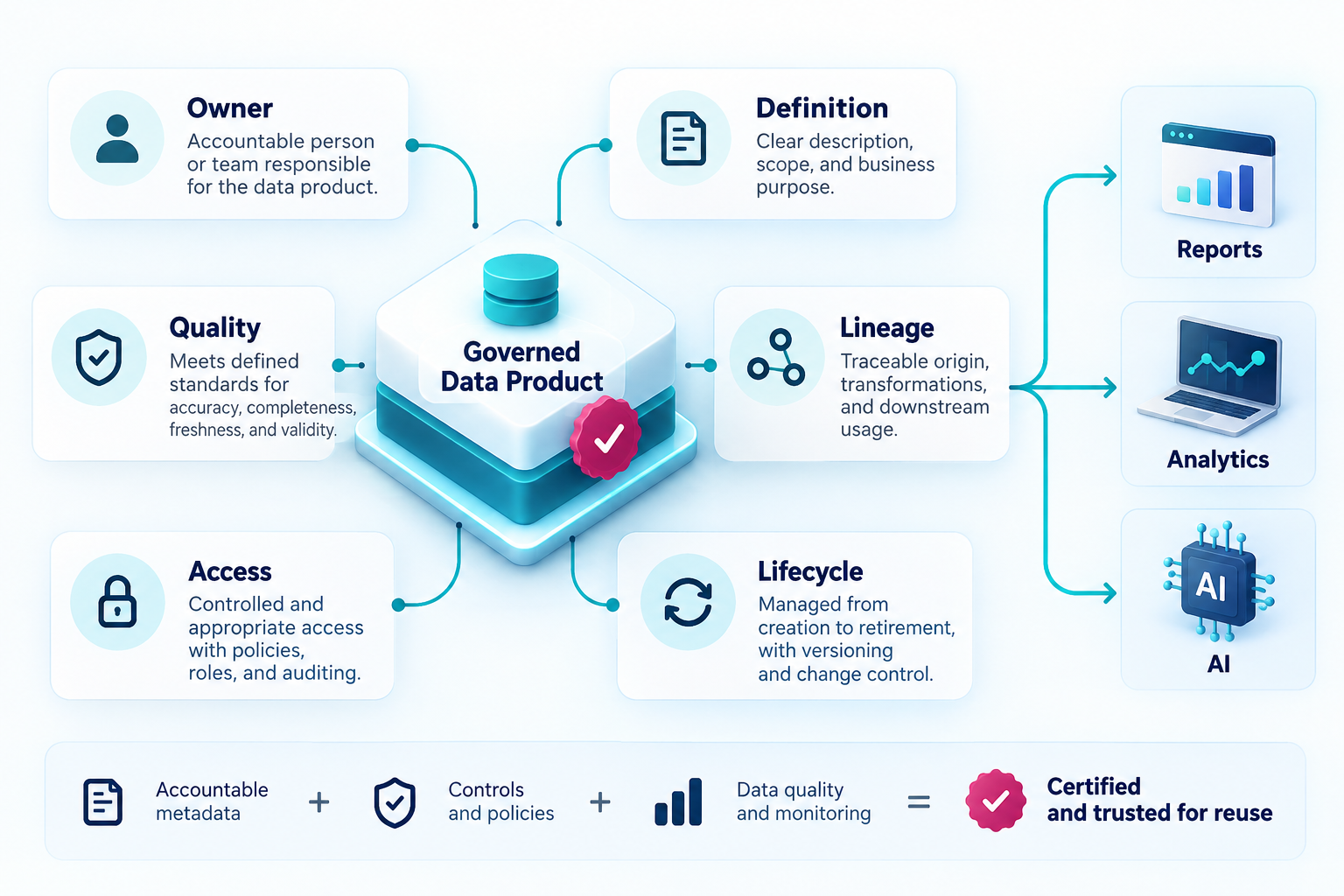
A certification badge should summarize real accountability and controls—not substitute for them.
A governed data product is a reusable data asset with a clear purpose and a named owner. It includes definitions, quality expectations, lineage, access rules, and lifecycle decisions. It may be a lakehouse table, warehouse object, event stream, semantic model, or a curated combination of Fabric items.
The technical implementation can vary. The contract should not. A consumer should know what the product means, when it refreshes, how quality is measured, what uses are allowed, and where to ask for help.
This product mindset reduces duplicate pipelines and conflicting metrics. More importantly, it turns governance from a review gate into part of delivery.
Protection should follow the data
Governance is not only about finding data. Some data should be easy to discover and still difficult to access.
Microsoft Fabric provides native security and governance controls, while Microsoft Purview adds broader protection and compliance capabilities. Sensitivity labels can classify and protect Fabric items, including through supported export paths. Purview data loss prevention policies can monitor supported structured Fabric data, and audit and risk capabilities help teams understand how sensitive information is being used.
The practical design still matters. Access decisions should align across tenant, capacity, workspace, item, and data layers. Roles should be assigned deliberately. Sensitive fields may need additional controls in semantic models or downstream experiences. Service principals, sharing paths, and exports need the same attention as interactive users.
The goal is defensible access: the right people can use the right data for the right purpose, and the organization can explain why.
Shared business meaning is the bridge to AI
Analytics has always needed consistent definitions. AI makes that need harder to ignore.
A semantic model can provide trusted measures, relationships, hierarchies, and business-friendly names for reporting. Fabric IQ builds on the data foundation with shared business context. Its ontology capability, currently in preview, can represent entities such as Customer, Product, Asset, or Shipment, along with their properties, relationships, rules, metrics, and bindings to enterprise data.
That context can help people, applications, and AI agents reason in the language of the business instead of guessing from table and column names.
But ontology is not a magic layer sprinkled over inconsistent data. It works best after ownership, quality, discoverability, and protection are already taking shape. AI-ready does not mean buying an AI license and waiting for the spreadsheets to become sentient. It means giving intelligent experiences data and definitions they can safely rely on.
A practical Fabric governance roadmap
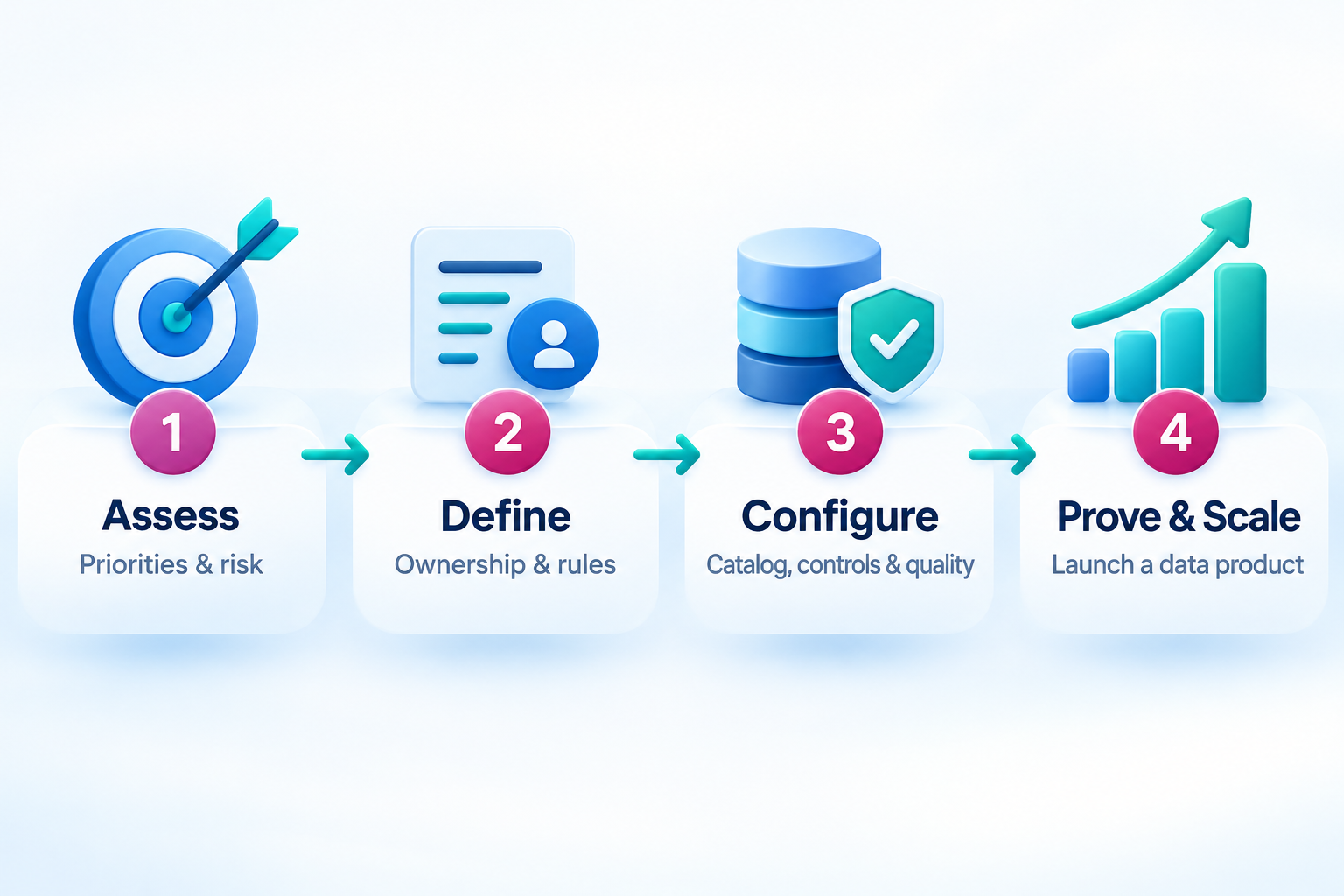
Start with one meaningful outcome, prove the model, and scale what works.
1. Assess the estate and choose the outcome
Inventory the Fabric estate, understand priority domains, identify sensitive data and risk, and interview the people who create and consume information. Select a use case where trust, discovery, access, or duplicated effort is causing visible business pain.
The output is not just an assessment deck. It is a prioritized backlog, a target outcome, and a small number of measures that will tell you whether the work helped.
2. Define ownership and operating rules
Assign owners and stewards, clarify decision rights, and agree on the minimum standards for metadata, endorsement, quality, access, and lifecycle. Keep the model proportionate. A certified finance dataset and an experimental notebook should not require identical controls.
3. Configure the governance foundation
Implement the capabilities that support the operating model: domains, workspace patterns, OneLake catalog metadata, tags, endorsement, lineage, sensitivity labels, access controls, quality monitoring, and the relevant Purview integrations.
Automation is useful here. Templates, deployment pipelines, APIs, and repeatable checks reduce manual work and make the preferred path the easiest path.
4. Prove it with a governed data product
Take one high-value use case from source to trusted consumption. Document the product, assign ownership, implement quality and access controls, expose it through the catalog, and measure adoption and outcomes.
Then improve the pattern before scaling it. It is much cheaper to discover that a policy is confusing with one product than with 200.
How Kumo Partners can help
We help organizations make governance practical inside Microsoft Fabric—close enough to delivery that teams use it, and structured enough that leaders can trust it.
Governance Diagnostic & Roadmap
We assess your current Fabric estate, operating model, metadata, security posture, and delivery practices. You receive a prioritized roadmap tied to business outcomes, risk, architecture decisions, and achievable stages—not a maturity score that looks impressive and then lives quietly in SharePoint.
Governance Operating Model
We define roles, decision rights, policies, escalation paths, and working practices that fit your organization. The result is a lightweight model that explains who decides, who delivers, what evidence is required, and how exceptions are handled.
Fabric Governance Foundation
We design and implement the technical foundation across the OneLake catalog, Fabric domains and workspaces, metadata, lineage, endorsement, sensitivity labels, access patterns, quality monitoring, and Microsoft Purview integrations. We also create reusable templates and automation so governance becomes part of normal delivery.
Governed Data Product Launch
We take a real business use case from design to a discoverable, documented, quality-controlled, and appropriately protected data product. This proves the operating model, gives teams something useful immediately, and creates a repeatable pattern for the next products.
Fabric IQ Ontology Pilot
When the data foundation is ready, we model a focused set of business entities, relationships, definitions, metrics, and rules using Fabric IQ ontology capabilities. The pilot is designed to test whether shared context improves search, lineage, analytics, or AI scenarios before you invest in a broader semantic layer.
Measure what changed
Governance should produce observable improvements. Depending on the outcome, useful measures can include:
- Time required to find an approved dataset or metric.
- Percentage of priority data products with named owners and complete metadata.
- Coverage of sensitivity labels, lineage, quality rules, and certification.
- Time to approve appropriate access.
- Number of duplicate pipelines, models, or reports retired.
- Data-quality incidents detected before they reach a decision-maker.
- Adoption and reuse of governed data products.
- Time needed to launch a new analytics or AI use case.
Not every metric needs a dashboard on day one. Yes, we realize the irony of saying that on a data and analytics site.
You can start smaller than you think
You do not need to govern every item in Fabric before anyone receives value. Choose one domain, one decision, or one high-value data product. Put real ownership around it. Make it easy to find. Apply the right controls. Measure whether people trust and reuse it.
That gives you a credible pattern, evidence for the next investment, and a governance story that is about business value instead of meetings.
If your Fabric estate is growing faster than confidence in the data, Kumo Partners can help you assess where you are, design the operating model, configure the platform, and launch the first governed data product. We will even try to keep the steering committee reasonably sized.